How Website Page Loading Speed Affects SEO Rankings in 2026: Why a Faster Website Matters for Google
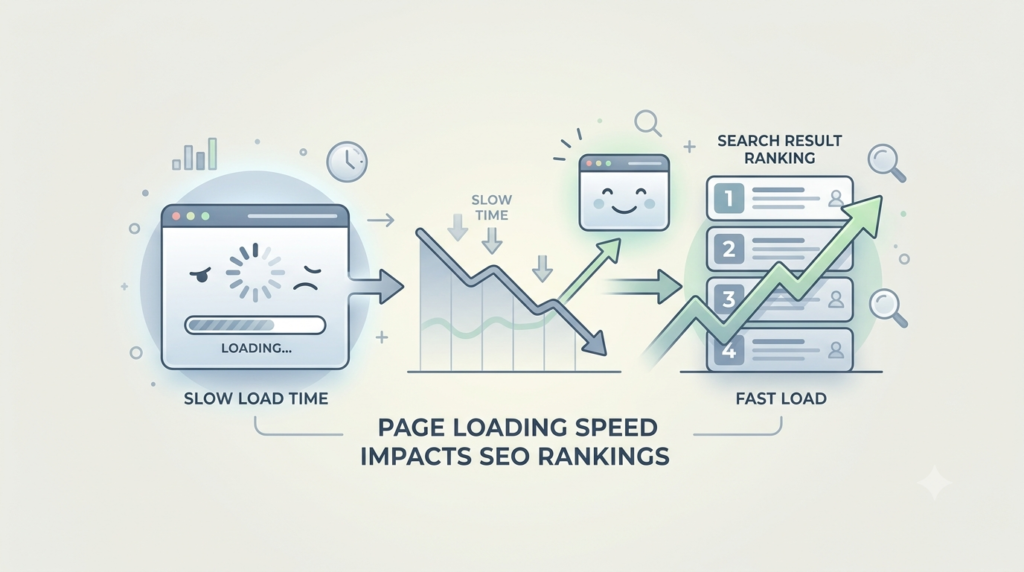
Website speed is no longer simply a technical concern for developers. It is closely connected to user experience, website usability, conversions, and modern SEO. When visitors click a search result, they expect the webpage to become usable quickly. If the page is slow, visitors may become frustrated and leave before reading the content or completing an enquiry.
For businesses competing in organic search, website performance should therefore be considered as part of a broader SEO strategy. While speed alone cannot guarantee a top ranking, a slow website can create unnecessary obstacles for users and search engines.
Understanding How Website Page Loading Speed Affects SEO Rankings can help website owners prioritize the technical improvements that support both user experience and long-term organic performance.
What Is Website Page Loading Speed?
Page loading speed refers to how quickly different parts of a webpage become available to visitors. However, website performance is more complex than measuring one single number.
A page may start displaying content quickly but still take time before the main content appears. Similarly, a page may look loaded but remain slow when users try to click a button or interact with a form.
This is why website owners should look beyond a simple “page load time” and consider multiple performance factors, including:
- Server response time
- Time required to display important content
- Image loading performance
- JavaScript execution
- Interactivity
- Visual stability
- Mobile performance
- Overall page usability
How Does Page Speed Affect SEO?
Google’s goal is to provide users with helpful and relevant search results. Website speed is one of several factors connected to the quality of the page experience.
However, it is important to avoid a common misunderstanding: making a website faster does not automatically guarantee higher rankings.
Content relevance, search intent, quality, authority, technical accessibility, and many other factors remain important. Nevertheless, poor website performance can negatively affect the experience visitors have after arriving from search results.
1. Faster Pages Improve User Experience
Users generally prefer websites that allow them to access information quickly. A fast-loading page makes it easier for visitors to read content, navigate through the website, and interact with important elements.
For example, a potential customer searching for a service may leave if the contact page takes too long to load. Improving performance can remove this unnecessary barrier.
2. Mobile Users May Benefit Significantly
Mobile devices can have different processing capabilities and network conditions compared with desktop computers. Large images, heavy scripts, and complex page designs may create a much slower experience on mobile devices.
Since mobile search is important for many businesses, mobile page performance should be regularly tested and improved.
3. Slow Speed Can Affect Engagement
When visitors face loading delays, they may not wait long enough to see the content. This can reduce opportunities for them to explore service pages, read blogs, fill out forms, or take other meaningful actions.
Improving speed does not guarantee a particular engagement metric. However, a faster and smoother website removes friction that may prevent users from interacting with the business.
4. Page Speed Supports Core Web Vitals
Website loading speed is closely related to performance metrics such as Largest Contentful Paint (LCP), Interaction to Next Paint (INP), and Cumulative Layout Shift (CLS).
For example, optimizing the delivery of the main visible content can improve LCP, while reducing unnecessary JavaScript may improve responsiveness. Properly reserving space for images and dynamic elements can help prevent layout shifts.
This means page speed optimization should be considered alongside broader Core Web Vitals improvements.
5. Crawling Efficiency Can Be Affected on Larger Websites
Large websites with thousands of URLs should also consider overall server and technical performance. Efficient websites can make it easier to maintain reliable access to pages and resources.
Crawling and indexing depend on many factors, so faster pages alone do not guarantee that more pages will be crawled or indexed. However, resolving server errors, timeouts, and significant performance problems can support a healthier technical foundation.
Common Reasons Why Websites Load Slowly
There are many possible reasons for poor page performance.
Large and Unoptimized Images
High-resolution images can significantly increase the amount of data visitors need to download. Images should be appropriately compressed and sized for their intended display area.
Poor Hosting or Slow Server Response
The server must respond before the browser can begin loading important resources. Slow hosting, overloaded servers, inefficient databases, or poor configuration can affect the entire page.
Excessive JavaScript
Modern websites often include scripts for analytics, chat systems, advertising, animations, forms, and other functions. Too many scripts can delay loading and affect responsiveness.
Too Many Plugins or Third-Party Tools
Website plugins and external tools can provide useful features, but unnecessary ones may increase the number of files and requests required to load a page.
Heavy Themes and Page Builders
Complex themes and poorly optimized page designs may generate excessive code. A visually attractive website should still be built with performance in mind.
Lack of Caching
Caching can reduce repeated processing and improve how quickly resources are delivered to visitors.
15 Ways to Improve Website Page Loading Speed
Here are practical ways to improve website performance:
- Compress and optimize images.
- Use appropriately sized images for different devices.
- Consider modern image formats where suitable.
- Improve server response time.
- Use reliable website hosting.
- Enable browser and server-side caching where appropriate.
- Remove unnecessary plugins.
- Review third-party scripts.
- Minimize unused CSS and JavaScript.
Reduce heavy page elements.
- Optimize fonts and their loading behaviour.
- Use a content delivery solution where appropriate.
- Improve database performance.
- Regularly monitor mobile and desktop speed.
- Test performance after major website updates.
At DigiKliQ Infotech, page speed optimization can be approached as part of a complete technical SEO process rather than focusing only on achieving a single score in a speed-testing tool.
Should You Focus Only on Getting a Perfect Speed Score?
No. A perfect score is not always necessary, and chasing a score without considering usability can lead to poor decisions.
The priority should be creating a website that loads important content efficiently, works smoothly for real users, and supports business goals. Removing essential features simply to achieve a perfect test score may not always be the right solution.
Instead, identify meaningful bottlenecks and prioritize improvements that have a genuine impact on visitors.
Conclusion
A faster website can support SEO by creating a better user experience, improving mobile usability, reducing technical friction, and contributing to stronger overall website performance. However, speed should be viewed as one important part of SEO rather than a guaranteed ranking solution.
The strongest approach combines performance optimization with useful content, search-intent targeting, technical SEO, website accessibility, and a clear user journey.At DigiKliQ Infotech, businesses can benefit from reviewing website performance regularly and addressing technical issues before they create larger problems for users and organic search visibility. A fast, stable, and responsive website provides a stronger foundation for long-term digital growth.