AI SEO vs Traditional SEO What Every Business Must Know to Rank in ChatGPT, Google AI Overviews & Gemini in 2026
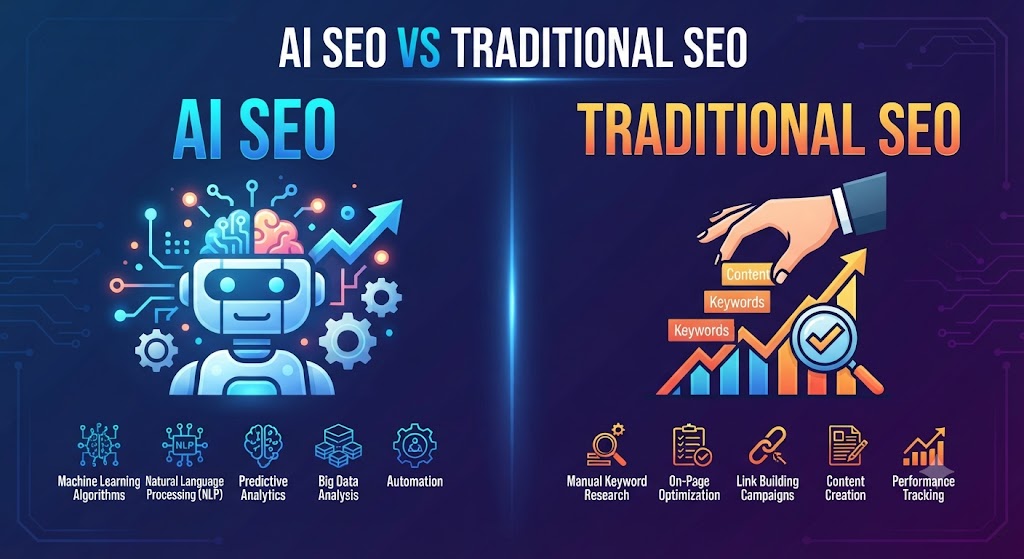
Search engine optimization has changed dramatically over the past decade. Businesses once focused solely on ranking on the first page of Google by targeting keywords and building backlinks. While those practices are still valuable, the rise of artificial intelligence has introduced a new way for people to discover information online.
Today, users are increasingly asking questions on AI-powered platforms like ChatGPT, Google AI Overviews, and Google Gemini instead of performing traditional keyword searches. These AI systems provide direct answers by analyzing information from trusted sources rather than simply listing webpages.
This evolution has given rise to AI SEO, a modern approach that helps businesses improve their visibility in AI-generated search experiences. Understanding the differences between AI SEO and traditional SEO is essential for businesses that want to remain competitive in 2026 and beyond.
What Is Traditional SEO?
Traditional SEO is the practice of optimizing a website so it ranks higher in search engine results pages (SERPs). The goal is to attract organic traffic by improving visibility for relevant keywords.
Traditional SEO generally focuses on:
- Keyword research
- On-page optimization
- Meta titles and descriptions
- Technical SEO
- Internal linking
- Link building
- Content marketing
- Website performance
- Mobile optimization
For years, this strategy has helped businesses generate qualified traffic from search engines such as Google and Bing.
Although traditional SEO remains important, search behavior is changing rapidly.
What Is AI SEO?
AI SEO focuses on optimizing content so artificial intelligence platforms can understand, trust, and reference your business when generating answers.
Instead of optimizing only for search rankings, AI SEO aims to make your website an authoritative source that AI assistants can confidently use.
AI SEO supports visibility across platforms including:
- ChatGPT
- Google AI Overviews
- Google Gemini
- Perplexity AI
- Claude
- Microsoft Copilot
Rather than relying solely on keywords, AI systems evaluate the quality, clarity, relevance, accuracy, and authority of your content.
How Search Has Changed
A few years ago, users searched using short phrases like:
- Best SEO company
- Digital marketing agency
- Website development services
Today, users ask complete questions such as:
- Which digital marketing company offers AI SEO services for manufacturing businesses?
- How can I improve my website’s visibility in ChatGPT?
- What is the difference between SEO, AEO, and GEO?
AI platforms generate detailed responses instead of displaying only search results.
Businesses that create comprehensive, trustworthy content have a greater chance of being included in these AI-generated answers.
Traditional SEO vs AI SEO
Although both strategies aim to improve online visibility, their priorities differ.
| Traditional SEO | AI SEO |
| Focuses on search rankings | Focuses on AI-generated answers |
| Targets keywords | Targets user intent and complete questions |
| Optimizes webpages | Optimizes knowledge and expertise |
| Measures rankings | Measures AI visibility and authority |
| Emphasizes backlinks | Emphasizes trust, accuracy, and context |
| Competes for clicks | Competes to become a cited information source |
The most successful businesses now combine both approaches rather than choosing one over the other.
Why AI SEO Matters in 2026
Artificial intelligence is changing how consumers research products and services.
Many users now receive answers without visiting multiple websites.
This means businesses need to create content that AI systems consider reliable enough to reference.
AI SEO offers several benefits:
- Increased brand visibility
- Higher online authority
- Better customer trust
- Improved content quality
- Greater exposure across multiple AI platforms
- Long-term competitive advantage
Businesses that ignore AI SEO may find it increasingly difficult to remain visible as AI-powered search continues to grow.
Key Elements of AI SEO
1. Answer Real Questions
AI models prioritize content that directly answers user questions.
Instead of writing only keyword-focused articles, create content around common customer queries.
Include:
- Frequently Asked Questions
- Step-by-step guides
- Industry explanations
- Comparison articles
- Expert insights
Helpful content is far more valuable than keyword-heavy content.
2. Build Topical Authority
Publishing isolated blog posts is no longer enough.
Develop complete content clusters around your expertise.
For example, a digital marketing agency should publish content covering:
- SEO
- AI SEO
- Generative Engine Optimization (GEO)
- Answer Engine Optimization (AEO)
- Local SEO
- Technical SEO
- Content marketing
- Google Business Profile optimization
This helps AI systems recognize your website as an authority within your niche.
3. Improve Content Structure
AI platforms process well-organized content more effectively.
Use:
- Clear headings
- Short paragraphs
- Bullet points
- Tables
- Definitions
- Summary sections
Good formatting benefits both readers and AI systems.
4. Maintain Technical Excellence
A technically healthy website improves crawlability and content accessibility.
Important factors include:
- Fast loading pages
- Mobile responsiveness
- HTTPS security
- XML sitemap
- Robots.txt optimization
- Canonical tags
- Internal linking
- Schema markup
Technical SEO remains the foundation for AI SEO success.
5. Demonstrate Expertise
AI systems favor trustworthy information.
Support your content with:
- Real experience
- Industry knowledge
- Updated statistics
- Practical examples
- Original research
- Professional insights
High-quality information is more likely to be referenced by AI-generated responses.
The Role of Structured Data
Schema markup helps search engines and AI systems understand your content.
Useful schema includes:
- Organization
- Article
- FAQ
- Service
- Local Business
- Breadcrumb
- Review
Although schema alone won’t guarantee AI visibility, it improves content interpretation and supports better indexing.
Common AI SEO Mistakes
Many businesses reduce their AI visibility by making avoidable mistakes such as:
- Publishing duplicate content
- Writing only for keywords
- Ignoring user intent
- Using outdated information
- Creating thin blog posts
- Neglecting technical SEO
- Avoiding structured data
- Failing to update existing content
Focusing on quality instead of quantity produces stronger long-term results.
The Future of Search Is Hybrid
Traditional SEO is not disappearing. Instead, it is evolving alongside AI-powered search experiences.
Businesses should continue optimizing for Google rankings while also creating content that AI platforms can understand and trust.
The future belongs to organizations that invest in both traditional search optimization and AI-driven visibility.
Final Thoughts
As AI continues transforming the way people search online, businesses must adapt their digital marketing strategies accordingly. Traditional SEO remains essential for earning visibility in search engine results, but AI SEO is becoming equally important for appearing in AI-generated answers across platforms like ChatGPT, Google AI Overviews, and Gemini.
Combining high-quality content, technical optimization, structured data, and topical authority creates a strong foundation for long-term online success. Companies that begin implementing AI SEO today will be better prepared for the future of search. At DigiKliQ, we help businesses stay ahead by combining traditional SEO with modern AI SEO, Answer Engine Optimization (AEO), and Generative Engine Optimization (GEO) strategies. Whether your goal is to improve Google rankings or increase visibility in AI-powered search platforms, DigiKliQ develops customized digital marketing solutions designed for the evolving search landscape. Partnering with DigiKliQ ensures your business is ready to compete not only in search engines but also in the next generation of AI-driven discovery.